Course Syllabus
Course Information
Course name and number: CPSC 6109 - Algorithms Analysis and Design
Credit Hours: 3
Course Description: The need for efficient algorithms arises in nearly every area of computer science. This course covers the modern theory of algorithms, focusing on the themes of efficient algorithms and intractable problems. The course introduces many of the techniques that apply broadly in the design of efficient algorithms, and study their application in a wide range of application domains and computational models. Topics include Basic Data Structuring Problems, Recursion, Computational Complexity, Graph Algorithms, Greedy Algorithms, Dynamic Data Structures, Hashing, Approximation Algorithms, Linear programming, Parallel Algorithms and Novel Approaches to NP-Complete Problems.
Required Competencies/Prerequisites: None
Course Offering (days/times and room):
- Section 01 (in-person): 1:30 - 2:45 pm Wednesdays and Fridays in SCCT 409
- Section V01 (online): None
Course Registration Number (CRN):
- Section 01 (in-person): 20760
- Section V01 (online): 20767
Websites:
- The course schedule, assignment descriptions, etc. are hosted at http://csc.ColumbusState.edu/carroll/6109/.
- Grades for each assignment, assignment submissions, quizzes, etc. are hosted in CougarVIEW.
The last day to drop without a grade and receive a 100% refund: Friday, January 16 2026
Instructor Information
- Name: Dr. Hyrum D. Carroll
- E-mail: carroll_hyrum@ColumbusState.edu
- Phone: (706) 507-8182
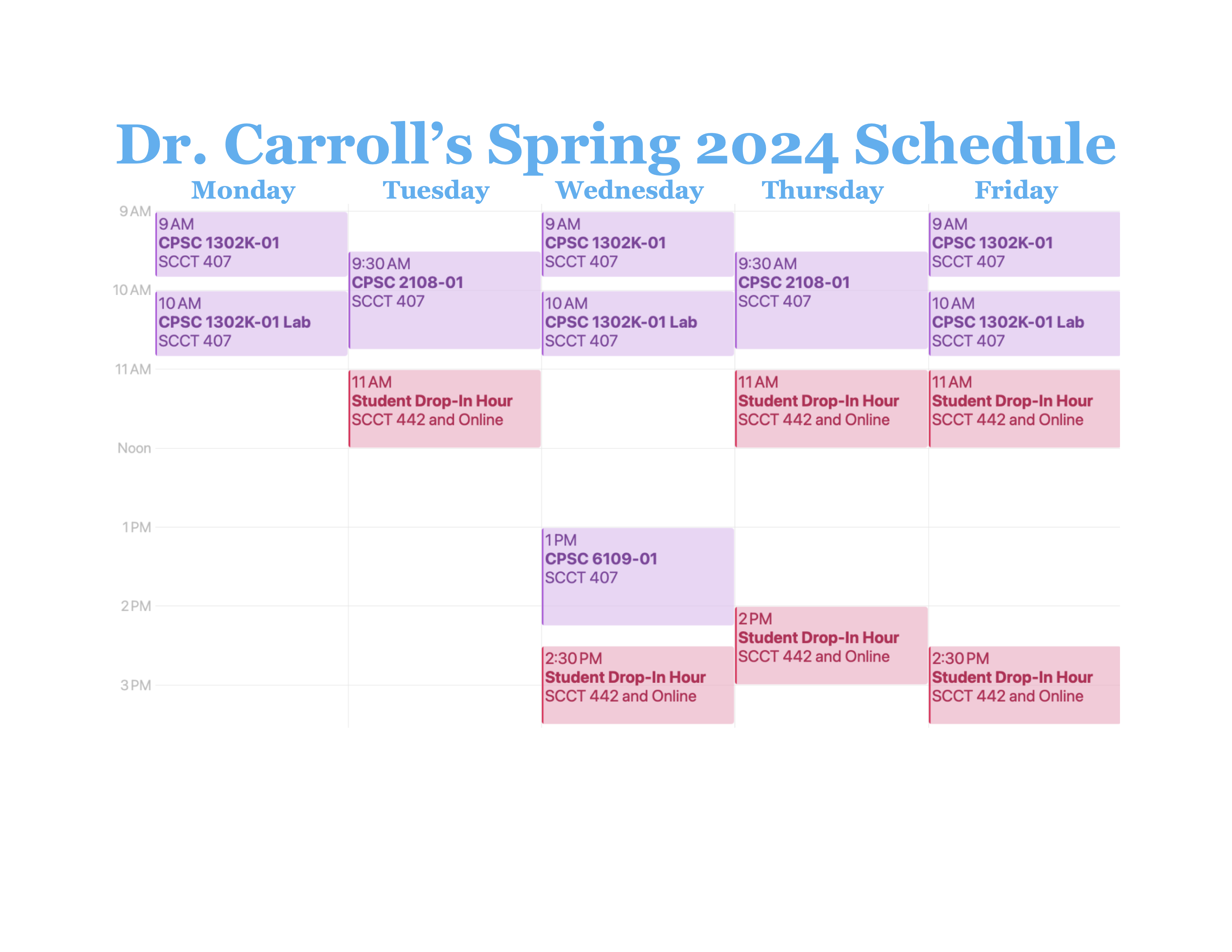
- Student Drop-in Hours:
I will keep the following Student Drop-In Hours. I will be both in my office and available online. I can also be available at other times by scheduling an appointment at https://drcarroll.youcanbook.me/. During my regular Student Drop-In Hours (if I don't have a meeting) you can start a video chat with me by clicking HERE.
Student Drop-In Hours Day Times Mondays 11:00 am – 12:00 pm
1:30 – 2:30 pmTuesdays 12:30 – 1:30 pm Wednesdays 11:00 am – 12:00 pm Thursdays 12:30 – 1:30 pm Fridays 11:00 am – 12:00 pm Walk-ins welcome and other times by appointment 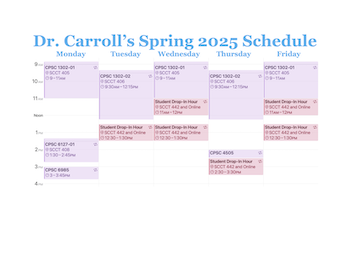


Textbooks and Materials
Required Textbook

Introduction to Algorithms, Fourth Edition
Thomas H. Cormen, Charles E. Leiserson, Ronald L. Rivest, and Clifford Stein
ISBN: 9780262046305
Resources
We will use Java as the programming language for this course. You can use the IDE of your choice. For example, Netbeans IDE 8 or above (available for free download at: http://www.netbeans.org/). You will need access to a computer with Java. Note, the computers in the labs on the SCCT building have Netbeans.Modules
- Computational Complexity & Recursion
- Sorting Algorithms
- Dynamic Data Structures & Binary Search Trees
- Hashing
- Dynamic Programming
- Greedy Algorithms
- Elementary Graph Algorithms
- Minimum Spanning Trees
- Single-Source Shortest Paths
- Parallel Algorithms
- Linear programming
- NP-Completeness
- Approximation Algorithms
Course Learning Outcomes
Course Objective: Upon completion of this course, students will- Learn how to design efficient algorithms and to recognize situations where this is not possible.
- Analyze the asymptotic performance of algorithms.
- Demonstrate a familiarity with major algorithms and data structures.
- Apply important algorithmic design paradigms and methods of analysis.
- Synthesize efficient algorithms in common engineering design situations.
Activity Expectations and Assignment Requirements
Attendance
Section 01 (in-person)
I expect each student to be in attendance for each class in-person. Attendance will be calculated by your arrival and duration in class. It is your responsibility to make sure your attendance gets recorded correctly for every class meeting (see under Student Responsibilities below). If you cannot make a class, please inform me and get the relevant materials from a classmate.
Computers are permitted in lecture for note taking and completing exercises. Other activities such as web surfing, stock trading, and social networking are inappropriate. Not only do they distract you but also others.
Students that do not attend both of the first two lectures may be dropped from the course. Refer to the CSU Catalog (https://catalog.columbusstate.edu/academic-regulations/undergraduate-academic-regulations/) for more information on class attendance and withdrawal.
Section V01 (Online)
Attendance will be calculated for each module by calculating if at least 70% of the activities for that module were completed.
AI Policy
Artificial Intelligence (AI) tools, such as ChatGPT or Microsoft CoPilot, enable assistance in a variety of areas such as: brainstorming, outlining, learning, studying, code explanation of examples, practice questions, and understanding compilation errors. All of these areas are appropriate for this course (when used appropriately). Be aware that AI tools may not always be reliable. If you use an AI tool to assist with a graded assignment, include a statement like the following: "[AI tool name] was used in the preparation of this assignment. It was used in the following way(s): [e.g., brainstorming, outlining, grammatical correction] for [portion of the assignment]."
These same tools can also thwart learning by providing easy solutions. Consequently, using these tools for solution generation is not permitted. Providing instructions for an assignment, quiz or exam to AI tools is not allowed for this course. You cannot unsee what you have seen. Use of an AI tool to provide a solution for a graded assignment is considered an act of academic dishonesty.
Projects
There will be multiple projects in this course. Projects must be written in Java. They are due at 10:00 PM Eastern Time on the assigned due date (unless indicated otherwise).
If an assignment contains portions that are more than 75% similar to other material (not provided by the instructor), zero points will be awarded
Additionally, an Academic Misconduct incident may be reported as well.
Students missing two or more projects will receive an F or FA in this course.
It is recommended that you regularly keep a copy of your projects on a second device.
Project Late Policy
A total of at most 3 project late days will be granted for the entire semester for projects (and only for projects). For example, if Project 2 is turned in two days late and Project 3 is turned in one day late, then all of the late days for the semester have been used.
Exams
There will be an exam during the regular semester (in addition to the final). This will be proctored using Respondus LockDown Browser and Respondus Monitor. Using Respondus Monitor requires a fee of $15 per year. Respondus Monitor requires a webcam to work. These tools are known to not work with the following devices:
- Chromebooks
- iPads/tablets
- Android devices
- Smartphones
- You can borrow a computer from the CSU library (or a friend)
- You can come to campus and use a computer in the Tutoring Lab, SCCT 450
- You can take a proctored exam at a library. Most libraries offer these services.
Final Exam
The course final is comprehensive. Respondus Lockdown Browser and Respondus Monitor are required for the final exam. The final exam will be proctored and available between Friday, May 8, 2026 – and Monday, May 11, 2026. Failing the final may result in not passing the class.
Grading
| Category | Percentage |
|---|---|
| Quizzes | 20% |
| Assignments and Projects | 40% |
| Midterm Exam | 20% |
| Final Exam | 20% |
Each of the grading categories is capped at 100%.
Course letter grades are determined by the final course average according to the following chart:| % Range | Course Grade |
|---|---|
| 90 – 100 | A |
| 80 – 89 | B |
| 70 – 79 | C |
| 60 – 69 | D |
| <60 | F |
Expectations
WHAT YOU CAN EXPECT FROM ME
- I will be prepared for lecture each day and will energetically present the material. I will ask questions to verify learning and understanding. I will answer all questions. They can be asked before class, during class, after class, via email or phone or during my Student Drop-in Hours (listed above).
- Below are my target response times:
Target Response Times Deliverable Target Email responses ≤ 2 school days Quizzes posted ≥ 4 days (so that it's open at least 3 days) Assignments posted ≥ 5 days before it's due Projects posted ≥ 7 days before it's due Quizzes graded ≤ 2 classes later Assignments graded ≤ 4 school days Discussion boards reviewed ≤ 5 school days Projects graded ≤ 7 days Exams graded ≤ 2 classes later
WHAT IS EXPECTED FROM YOU
Information regarding student rights and responsibilities can be found in the CSU Student Handbook.
As a student in this course, you are responsible to:
- Be respectful to both your peers and instructors in all interactions.
- Manage your time and maintain the discipline required to meet the course requirements.
- Be prepared to ask questions to maximize your understanding of the material.
- Complete all readings and watch all assigned videos,
- Complete all assignments,
- Complete all quizzes and exams,
- Ask questions when something is not clear.
- Actively participate in classroom discussions.
- Submit work that is completely your own creation and not author by someone or something else.
Course Communication
- Use your official CSU account for all e-mail communication.
- Regularly check your official CSU email (at least every 36 hours).
- Follow common sense in writing and sending e-mail. As this course is a semi-public space, be cautious about sharing personal information such as your address or phone number.
- Read and think about e-mail before sending. Email is a permanent record of your communication.
- To help me prioritize responding to your email, please start the subject line with "CPSC 6109: ".
Technical Requirements/ Support
See the CougarVIEW Starter Guide for support with navigating this system.
Hardware Requirements
See the System Checker here. (GeorgiaVIEW’s system checker is compatible with CougarVIEW.)
Software Requirements
- An office suite such as Microsoft Office or Open Office
- Microsoft Office 365 is available free to all CSU students through MyCSU.
- OpenOffice can be downloaded for free.
- Acrobat Reader offers additional features for PDF files.
Browser Plugins (.pdf files, QuickTime files, .mp4 files) can be obtained at a browser's website: